Mouse-free Marion Update
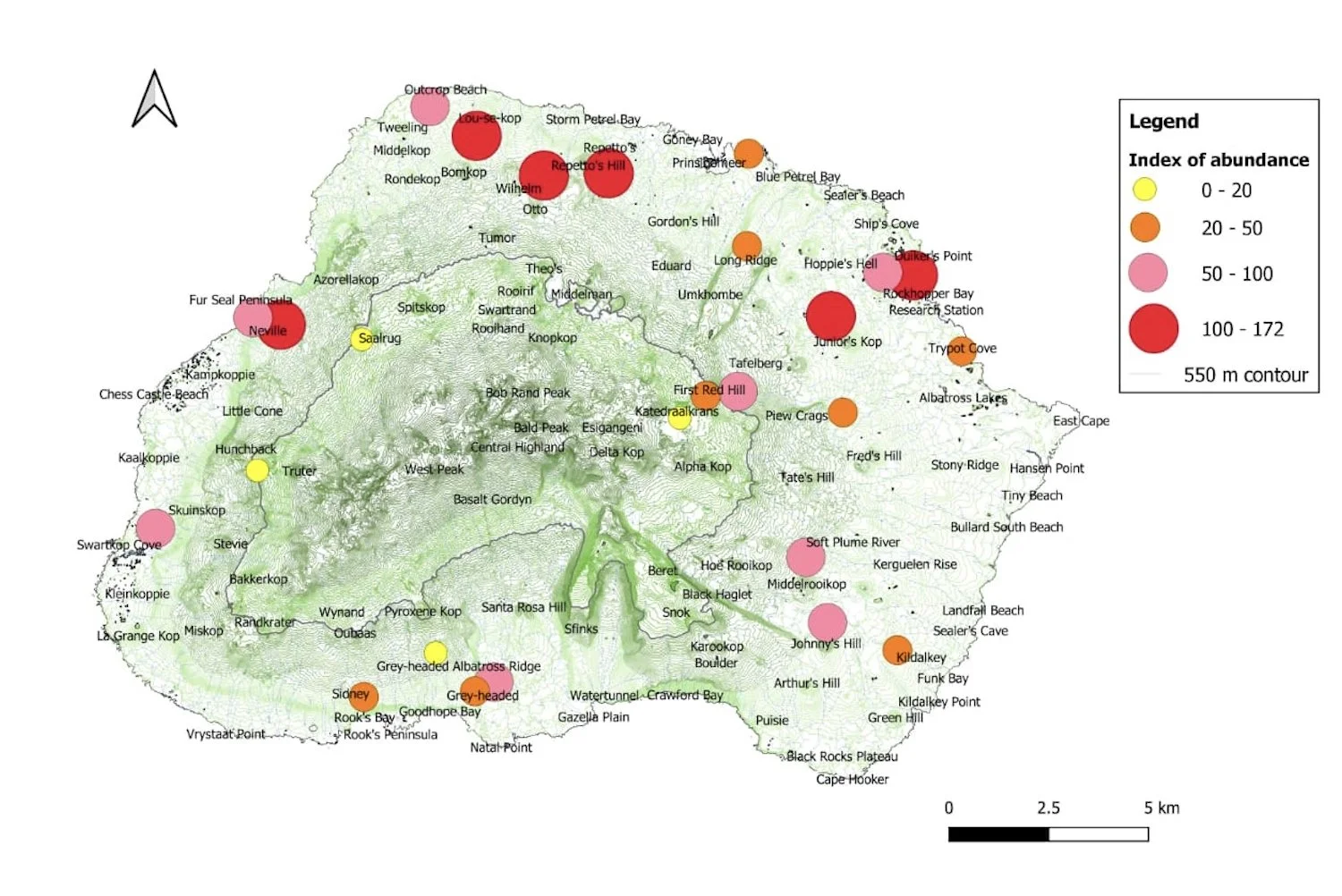
This map shows that early indications are that mice are less prevalent at higher latitudes in the polar desert. © Mouse-Free Marion Project.
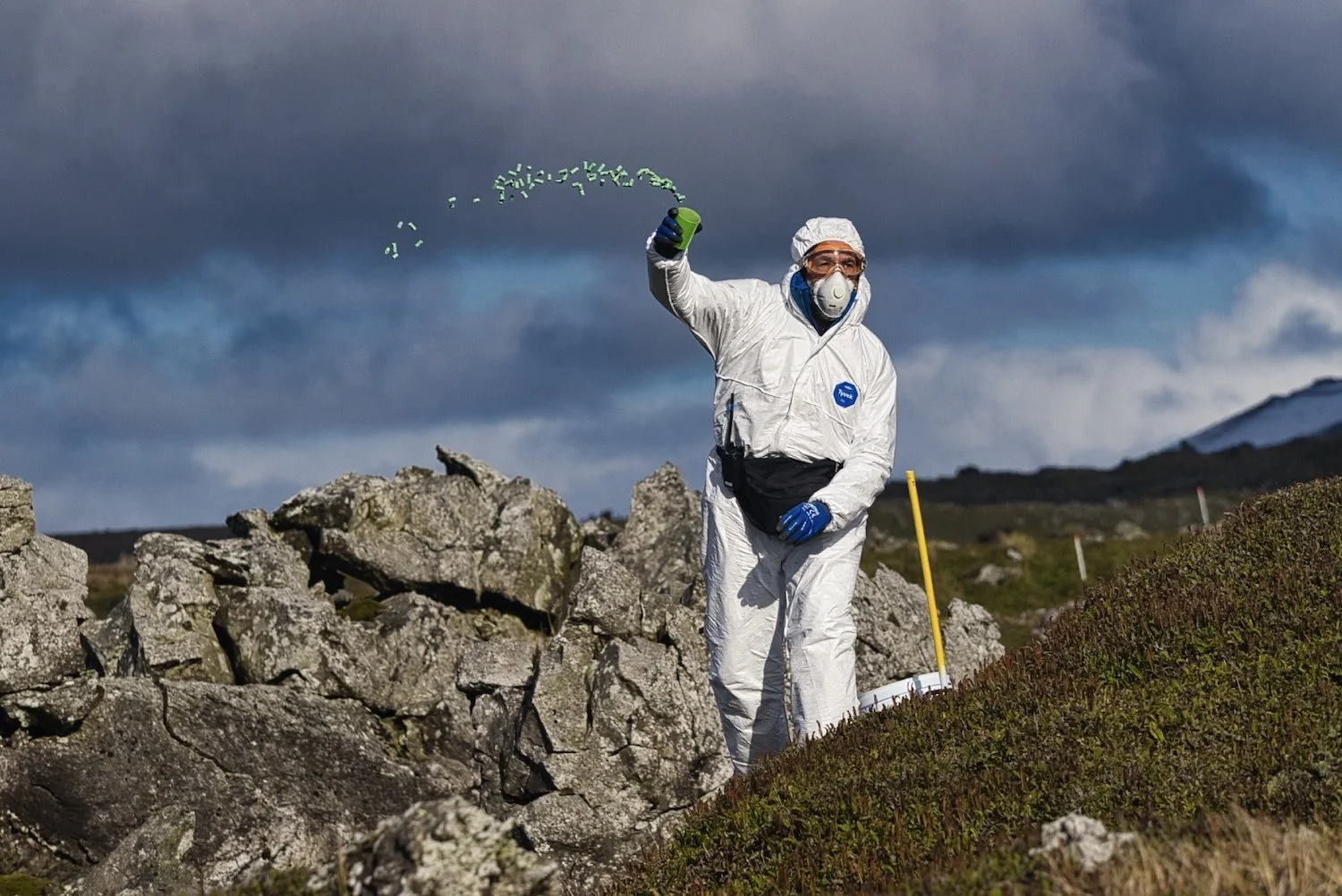
Hand baiting on Marion Island. Photo: © Roelf J. Daling, MFM Field Assistant.
I am honored to serve as the First Patron of the Mouse-Free Marion Project, a partnership between the South African Department of Forestry, Fisheries & the Environment and BirdLife South Africa. The Mouse-Free Marion Project, without a doubt, is the single most important research and eradication project in the world today.
South Africa’s sub-Antarctic Marion Island is the larger of the two Prince Edward Islands, which together provide globally important breeding sites for seabirds and other wildlife. This island group is home to almost half of the world’s Wandering Albatrosses along with millions of other seabirds.
The accidental introduction of mice in the early 19th century devastated populations of the native invertebrates, and mice have more recently resorted to preying on seabirds. The mice are literally eating the chicks alive and even the adults of both surface-nesting and burrowing seabirds. Without intervention, 19 of the 29 bird species on Marion Island could become locally extinct if invasive mice are not eradicated.
The Project Aims to Remove 100% of the Island’s Mouse Population
The Mouse-free Marion (MFM) team is continuing to push forward in 2026. The team is focused on meticulous project planning and pre-eradication field work on the island, as well as the corresponding fundraising efforts needed to pull off this very important mission. In this ambitious undertaking, the Mouse-Free Marion Project aims to remove 100% of the introduced mice from Marion Island. Keith Springer, the MFM Project Operations Manager stated that if we remove 99%, the eradication will not succeed. He explained: “We need to make sure that every mouse on the island has access to a piece of fresh bait, all within the same timeframe.” Roelf Daling and Vonica Perold, research assistants who joined the project in April 2025, are now well into their year on Marion Island.
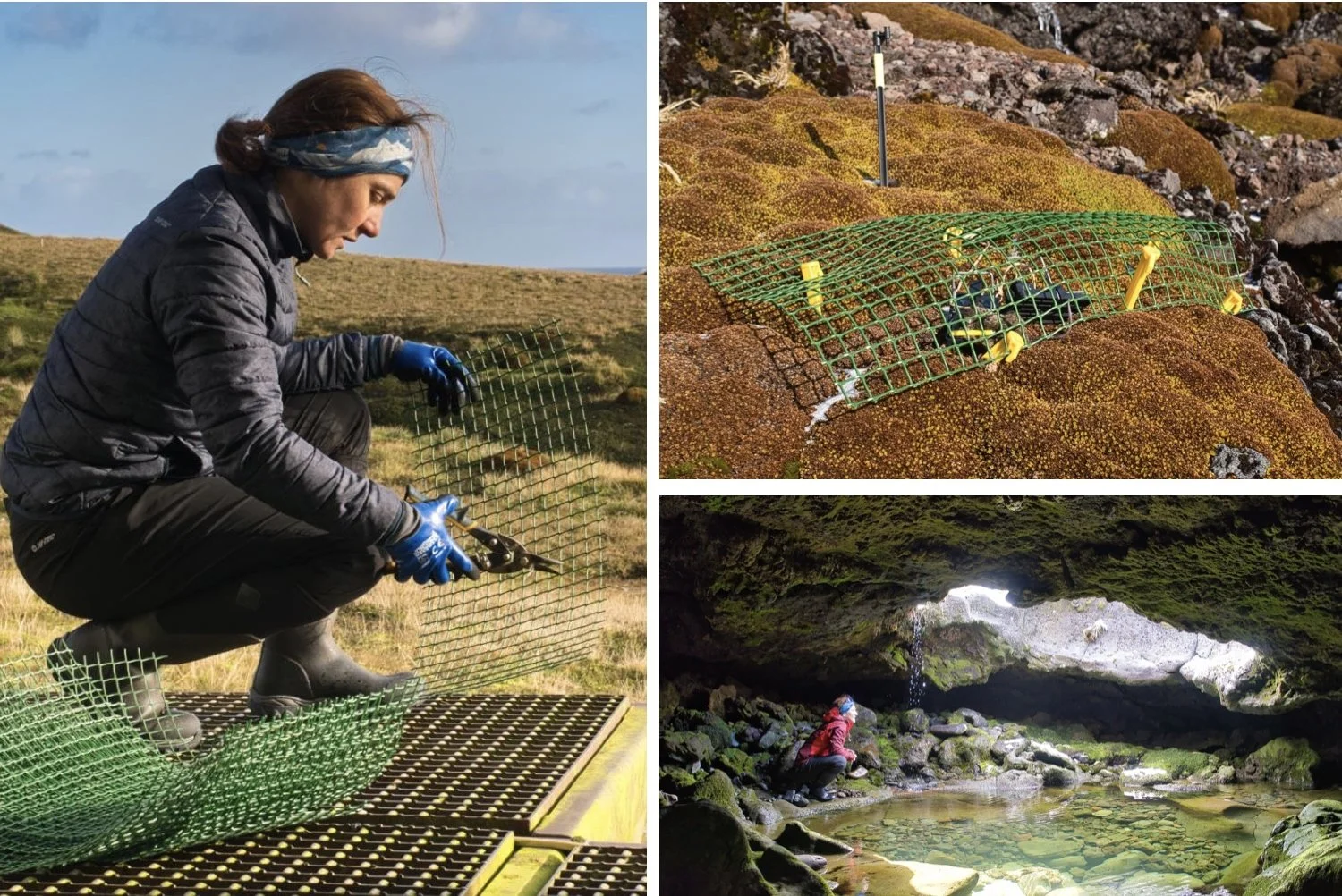
Above left: Vonica Perold builds trapping site. Above right: Each trapping sight has two mouse traps which are covered by a mesh to prevent bird interference. Researchers set these trap lines in various habitats across the 30 000 hectare island to measure abundance. Photos: © Roelf J. Daling
Step 1: Every Mouse on the Island
It is crucial that the team accurately estimates the number of mice on the island, and that number can fluctuate depending on the location and time of year. While it’s not possible to count every individual mouse, there are various techniques the MFM team can use to understand their relative abundance.
MFM has employed a technique known as “index trapping.” This method involves setting out a series of long trap lines to capture mice over a period of three nights within a specific habitat type. One of these trap-lines serves as a type of snapshot of the mouse population in that area. Another type of trapping recently implemented is called “V-lines” or longer lines spaced out over different elevations that run from the coast into the polar desert. The data will show how the mouse population fluctuates throughout the seasons across different altitudes and will affect the baiting strategy.
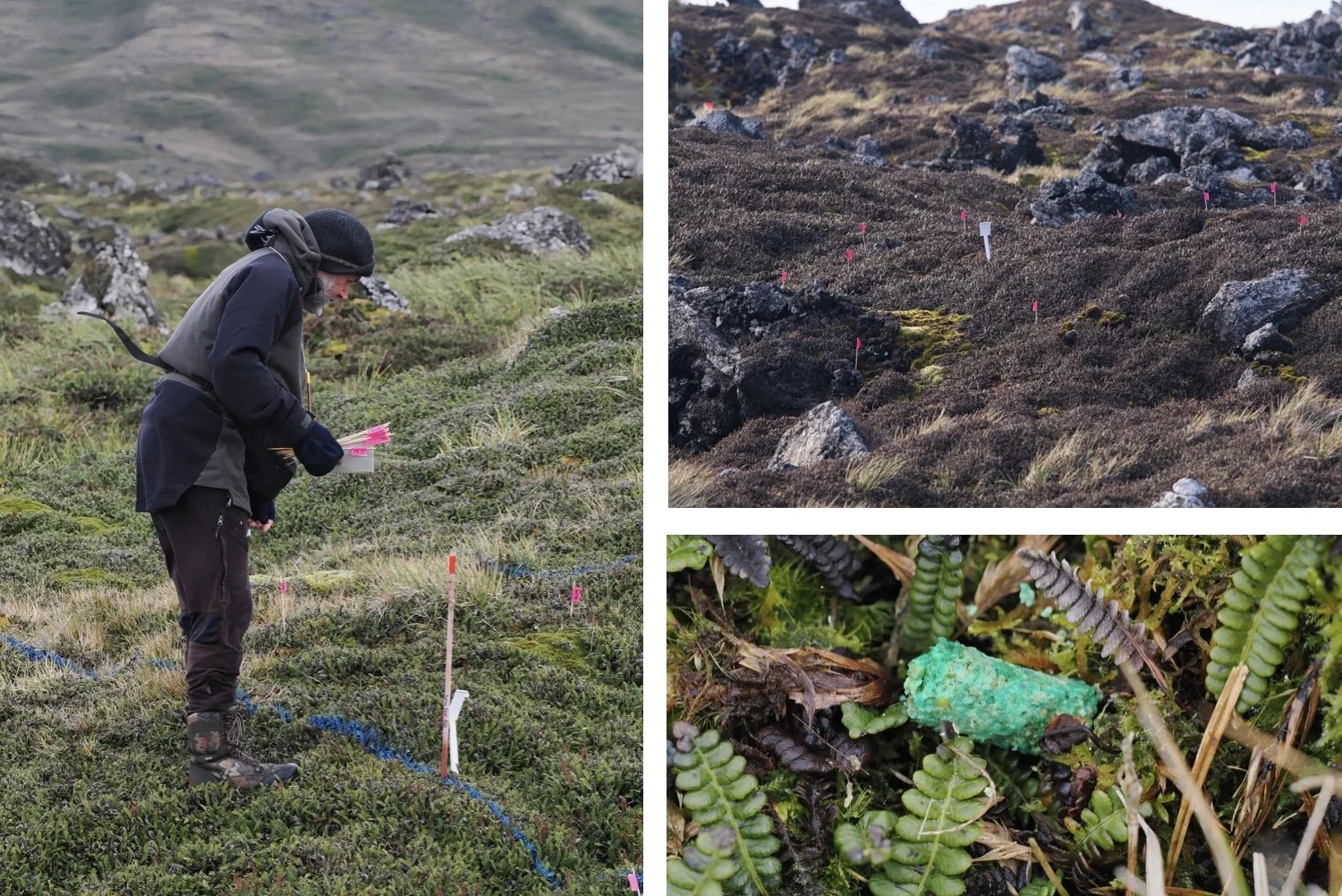
Above left: Keith Springer works on setting up one of the study sites on Marion Island. Above right: A bait monitoring plot where each pellet has been flagged. Bottom right: A rodenticide bait pellet. Photos: © Roelf J. Daling, MFM Field Assistant.
Step 2: Access to Fresh Bait
Correctly estimating the amount of bait required is also critical but can be challenging. Marion is a sub-Antarctic island with many obstacles such as rivers, boulders, ponds, cliffs, and crevices, where bait pellets can break down and get washed or blown away, frozen or lost. The MFM Project has conducted a series of baiting trials to understand the bait pellets’ performance and durability in typical Marion conditions at different elevations. These results provided essential information for the eradication, especially related to the timing of the operation.
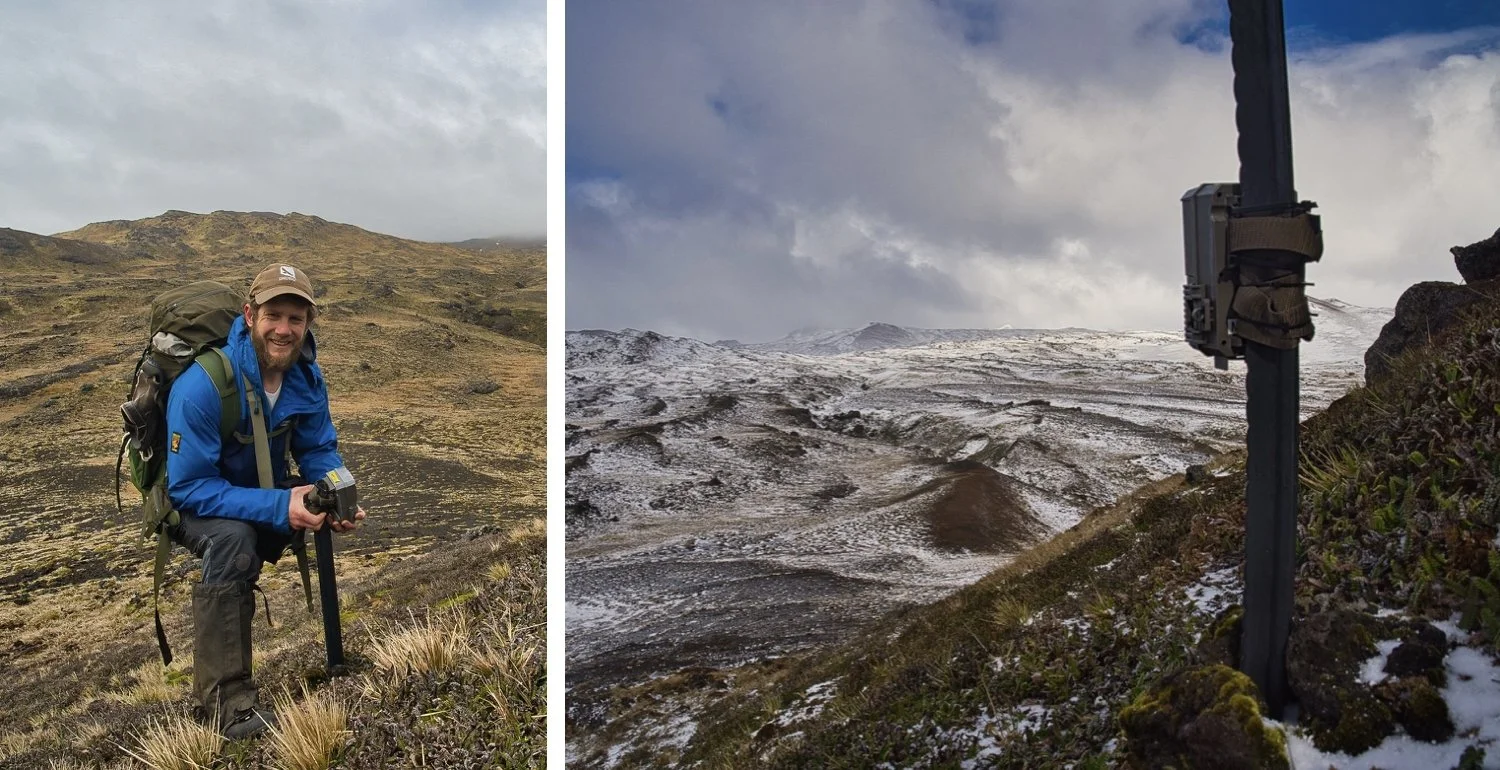
Above left: Roelf Daling sets up a trail camera on Marion Island. Above right: Trail cameras have been set up across Marion Island to gather cloud and weather data. Photos: © Roelf J. Daling, MFM Field Assistant
Step 3: Within the Same Timeframe
Helicopters will be deployed to spread bait pellets across the entire island and carefully timing this operation is crucial. Once the operation begins, it must continue quickly to cover the entire island. Any delays or gaps, might allow mice to return to spaces that have already been baited.
The weather plays a pivotal role in this process. The helicopter pilots consistently need clear conditions that are not too windy to keep the helicopter flying low and in a straight line to systematically deliver the bait. Using trail cameras at strategic locations across Marion, the MFM team has been monitoring the cloud cover and cloud height to determine the number of flyable hours for each month. The team is also anticipating running a helicopter baiting trial on Marion in April–May 2027.
Funding this Globally Important Project
The MFM team continues to make steady progress in raising funds for both the pre-eradication fieldwork and for the full operation. In fact, a news release just arrived from BirdLife South Africa announcing that the project has secured a transformational pledge of $10 million USD from a Swiss-based international foundation. With this pledge, the MFM Project has now secured approximately 60% of its overall funding target and is significantly closer to delivering one of the most ambitious island eradication operations undertaken in the sub-Antarctic.
How You Can Help
This news is quite encouraging, but we still have more work to do before the project is fully funded. I am so very grateful to those of you who have joined me in supporting this effort. For US residents, If you would like to make a contribution by check, donor-advised funds, or gifts of stock, please email me directly. We will help you to process your gift through U.S.-based Friends of South Georgia Island (FOSGI). You may also visit the MFM Project website at mousefreemarion.org. Thank you for helping to safeguard Marion Island’s globally important seabird populations for generations to come.